What AI cannot do is remember the sound of a system about to fail, or recognise the seemingly harmless design decision that caused it. That judgement develops through years of designing, testing and troubleshooting real machines. In our new series, Hydraulics Essentials, hydraulic engineering expert Peter Albers shares the practical knowledge he has accumulated during more than half a century in hydraulics. He will share his experience and insights on hydraulic principles, components, circuits, and design decisions from a practical engineering perspective.
Practical hydraulic knowledge, shared with the next generation of engineers
After studying mechanical engineering at the Technical University in Delft and working for several manufacturers and suppliers of both components and complete hydraulic systems, Peter set up ‘Ingenieursbureau Albers BV’, an independent consultancy service for the fluid power industry. As a hydraulic advisor, he delivered solutions and completed designs for machinery manufacturers, larger engineering offices, offshore operators and dredging companies.
Passing the torch
Knowledge transfer has always been an essential aspect of Peter's half-century in the hydraulic industry. “Passing the torch of expertise has always been extremely important to me”, Peter confides in a phone call. “This began as early as my military service. Back then, I already taught classes at the Royal Netherlands Navy in Den Helder, and I've continued to do so ever since.” A key part of his company's work has been transferring hydraulic knowledge through company-designed training courses.
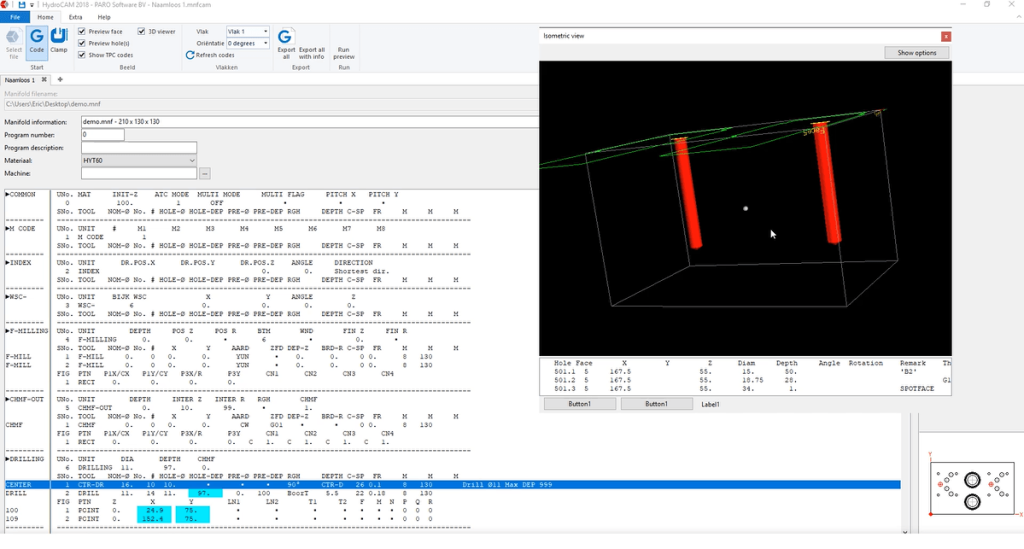
In his working life, he also came across Paro Software. “During the 1980s, as I founded my own engineering consultancy focused on hydraulics, just as Jos Paro senior, the founder of Paro Software, had done”, Peter continues. “In my work, I have repeatedly used Paro Software to design manifolds. Many times these objects were certainly not the smallest copies of hydraulic engineering.”

From Pascal to digital controls
In hydraulics, Pascal’s principle -formulated by the 17th-century mathematician and physicist- which states that pressure applied to a confined liquid is transmitted equally in all directions, still plays a foundational role. “That hasn’t changed, but technology doesn't stand still either. Digital control systems, such as PLCs, have advanced significantly. This has given us much better, more targeted control. What started with so-called servo valves has led to hydraulic components with much more electrotechnical control options. Especially for rotating drives such as winches, this has given us a whole new level of control. But let’s not forget that much in hydraulics has remained the same. Linear cylinder actuation is still hydraulics as it has always been. The advantages and capabilities of these hydraulic systems are enormous, with additional benefits for numerous applications.”
Throughout his career, Peter has built up a wealth of knowledge that goes beyond what you find in a component catalogue or technical manual. Knowing how individual components work is one thing; understanding how they interact as part of a complete hydraulic system is another. “Many engineers know how to size individual components, such as valves, for pressure and flow”, Peter explains. But understanding how the complete system behaves dynamically or in combination is often more challenging. That behaviour can have an important impact on which components you choose. These are exactly the kinds of topics I hope to explore in my contributions.”
Sharing practical hydraulic knowledge
Our ambition goes beyond publishing an occasional technical article. Together with Peter, we want to build a growing reference for practical hydraulic knowledge, a place where engineers can find clear explanations of common questions, challenges and design choices.
Each column will focus on a specific hydraulic topic. For example:
* When should you use a pilot-operated check valve, and when is a counterbalance valve the better choice?
* How do you safely hold a hydraulic cylinder in position?
* Why does hydraulic design need a thorough requirements analysis?
At Paro Software, we take our customers’ work seriously because we know it powers real machines. Hydraulics Essentials follows the same philosophy. That’s why we provide unlimited support from real engineers to our customers. That's also the goal of this series. It is not only to explain what works, but also why, and to share the practical engineering considerations behind each decision. With Hydraulics Essentials, we want to help pass that knowledge on to the engineers who will put it to work next.